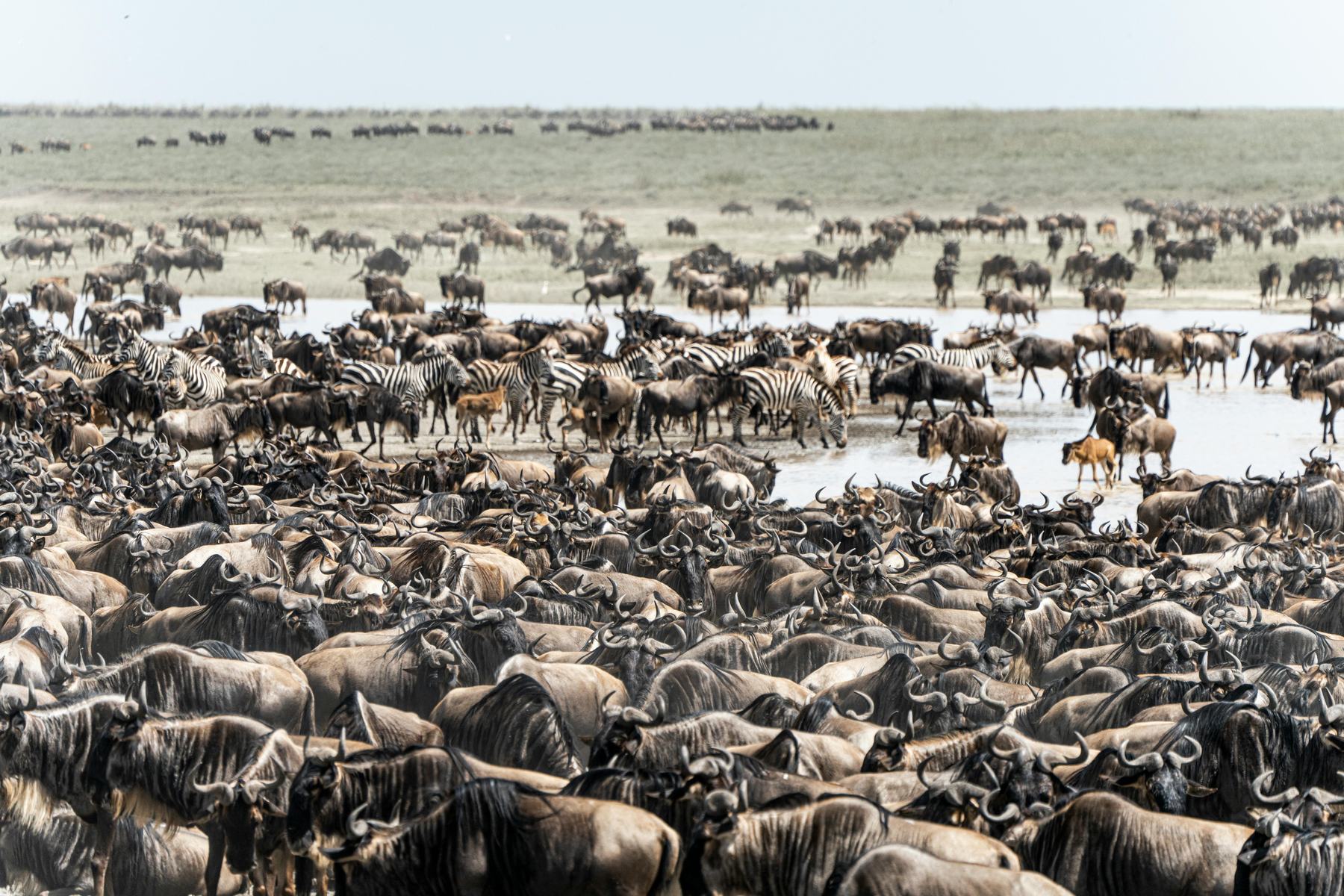
The Great Migration is not an event. It is a continuous, year-round circuit of roughly 1.3 million wildebeest, 250,000 zebra and several hundred thousand gazelle moving clockwise through the Serengeti–Mara ecosystem, following rainfall and fresh grass. There is no start and no finish, and the herds are somewhere in this system every single day of the year.
Which means the only real question is: where will they be when I am there? Below is our month-by-month best estimate for 2026, based on twenty years of records and where our own vehicles were in each month of the last five seasons.
One honest caveat
The herds follow rain, and rain does not follow calendars. In 2023 the short rains arrived three weeks early and the herds were on the short-grass plains by late November. In 2019 the Mara River crossings were still running into early November. Treat every month below as a strong probability, not a promise — and book a camp that can move, or an operator who will drive further to find them.
January to March — the southern plains and calving
The herds spread across the short-grass plains of the southern Serengeti and the Ndutu area of the Ngorongoro Conservation Area. This grass is short, mineral-rich and grows on volcanic soil that makes it exceptionally nutritious — which is precisely why the wildebeest come here to give birth.
Calving peaks in the first three weeks of February. Around 400,000 calves are born in a window of about three weeks, roughly 8,000 a day at the peak. It is a synchronised strategy: predators simply cannot eat them all fast enough.
For predator action, this is the best month of the year, full stop. Cheetah hunt on open ground where you can actually watch a chase from start to finish. Hyena clans work the edges of the herds constantly. Lion prides on the Ndutu marsh are unusually visible.
- Where to stay: seasonal mobile camps at Ndutu, Kusini or the Naabi area.
- Why it is underrated: off-road driving is permitted in the Ndutu conservation area, unlike inside the national park, which changes the photography entirely.
- Vehicles: a fraction of the July–October numbers.
April and May — the long rains and the move north-west
The long rains arrive and the herds begin drifting north and west through the central Serengeti towards the western corridor. Grass grows tall, game viewing gets harder, and a number of camps close entirely for the season.
This is the cheapest time to be in Tanzania by a wide margin — rates fall by 30 to 50 per cent — and the light after an afternoon storm is genuinely spectacular. It is also mud, and the odd cancelled game drive. We recommend it to photographers and to nobody else.
June and July — the western corridor and the Grumeti
The herds mass in the western corridor, following the Grumeti river towards Lake Victoria. The Grumeti crossings are smaller and less predictable than the famous Mara ones, but the crocodiles here are enormous — some over five metres — and there are far fewer vehicles at a sighting.
By late June the front-runners are pushing north. Early July usually finds the bulk of the herds somewhere between the Grumeti and the northern woodlands.
Late July to October — the Mara River crossings
This is the famous one. The herds reach the Mara River in the far northern Serengeti around Kogatende and Lamai, and cross — repeatedly, chaotically, and in both directions — between late July and late October.
A few things nobody tells you before you come:
- A crossing can take twenty minutes or four hours. The herds gather at the bank, mill about, and then one animal moves. You wait. That waiting is most of the day.
- They cross back the way they came, often the next day. It is not a one-way procession.
- You need three nights minimum in the north. One night gives you two drives and no margin at all.
- Stay on the Tanzanian side. The Kenyan Mara sees far more vehicles at the same river. Tanzania's northern Serengeti is quieter and the crossings are the same crossings.
November and December — the short rains and the return south
The short rains break in early to mid November and the herds turn south, moving down through the Lobo and Seronera areas towards the short-grass plains they left in April. By mid December most are back on the southern plains, and by late December the first calves arrive.
November is one of the quietest and best-value months in the Serengeti, and the game viewing in the central and northern areas remains excellent throughout.
Month by month at a glance for 2026
| Month | Likely location | What is happening | Where to sleep |
|---|---|---|---|
| January | Southern plains, Ndutu | Herds gathering, early calves | Ndutu mobile camps |
| February | Ndutu & Kusini | Calving peak, heavy predator action | Ndutu mobile camps |
| March | Southern & central plains | Calves strengthening, herds starting to drift | Ndutu or Seronera |
| April | Central Serengeti | Long rains, herds moving north-west | Seronera (many camps closed) |
| May | Western corridor | Rut begins; columns form | Grumeti area |
| June | Western corridor & Grumeti | Grumeti river crossings | Western corridor camps |
| July | Northern woodlands | Front-runners reach the Mara River | Kogatende / Lamai |
| August | Kogatende & Lamai | Peak Mara River crossings | Northern mobile camps |
| September | Northern Serengeti & Mara | Crossings continue both ways | Northern mobile camps |
| October | North, beginning to turn | Last crossings; herds drifting south | Kogatende / Lobo |
| November | Lobo & central Serengeti | Short rains; the long walk south | Seronera / Lobo |
| December | Southern plains | Herds arriving; first calves late month | Ndutu / Kusini |
So when should you actually go?
If you want the river crossings and you can travel in August or September, go then, and book eleven months out because the northern camps sell out. If you have any flexibility at all, we would gently point you at February. The calving is a spectacle of a completely different kind, the predator viewing is better, the landscape is green rather than dust-brown, there are perhaps a third as many vehicles, and it costs meaningfully less.
And if you can only travel in April or November, come anyway. The Serengeti holds enormous resident populations of lion, leopard, elephant and giraffe that never migrate anywhere, and you will have them largely to yourself.
The mistake is planning a trip around the migration and being disappointed by everything else. Plan a good Serengeti trip, put yourself in the right area for the season, and let the herds be the bonus they usually are.
Written in Arusha by Emmanuel Loibanguti. Questions? Ask us directly.